Swimwear Briefs: Men and Boys Are Wearing Bikinis and Thongs Around the World
Men’s swimwear is becoming smaller, more fitted and considerably more adventurous. The traditional swim brief remains an important part of beach culture, but today it sits within a much broader family of body-conscious styles that includes bikinis, low-rise briefs, micro briefs and thongs.
The change is particularly visible among adult men and younger adult men who are increasingly willing to wear styles that previous generations might have considered unusually revealing. Across parts of Europe and other regions where brief swimwear has long been familiar, this is hardly revolutionary. What is more noticeable is the growing visibility of these styles in places such as the United States, where board shorts and loose trunks dominated men’s recreational swimwear for decades.
The basic idea is simple: men don’t necessarily want to swim in shorts anymore.
They want choices.
The Swim Brief Never Really Went Away
Before discussing bikinis and thongs, it is important to remember that the men’s swim brief isn’t new.
Close-fitting men’s swimwear has a long history, particularly in competitive swimming and European beach culture. The familiar Speedo-style brief demonstrated that a man’s swimsuit could be small, practical and athletic without needing legs.
For generations, however, men’s swimwear culture differed dramatically depending on location.
At many European beaches and pools, seeing men wearing briefs was perfectly ordinary. In other places—particularly parts of the United States—longer trunks and board shorts became the dominant casual style.
That cultural divide is becoming less rigid.
Europe Has Long Embraced Men’s Brief Swimwear
Travel through Mediterranean and other European beach destinations and men’s brief-style swimwear is hardly unusual.
Depending on the country, beach and generation, visitors may encounter everything from conventional briefs and square-cut suits to bikinis and increasingly minimal styles.
European swim culture also helped normalize an important concept:
A small swimsuit doesn’t automatically say anything about a man’s sexuality.
A man wearing a brief might be straight, gay, bisexual or anything else. He might be wearing it because he swims seriously, because he likes tanning, because it is comfortable or simply because that is the style he prefers.
That distinction matters as men’s swimwear becomes increasingly international.
Men’s Bikinis Take the Brief Smaller
The men’s bikini is essentially the natural evolution of the swim brief.
Take a traditional brief and reduce the waistband and side coverage, lower the rise and reshape the front and back. The result can be noticeably smaller without fundamentally changing how the swimsuit works.
There are now many interpretations of the men’s bikini:
Classic Bikini: A straightforward low-rise suit with narrow sides and moderate rear coverage.
String-Side Bikini: Replaces wider side panels with very narrow straps or strings.
Brazilian-Inspired Bikini: Uses a smaller rear while retaining enough front coverage for swimming and beach activities.
Micro Bikini: Reduces the front, sides and rear substantially.
Pouch Bikini: Uses anatomical shaping at the front while minimizing the rest of the swimsuit.
Compression Bikini: Uses stretch construction to create a smoother and less projected profile.
This variety gives men considerably more control over how they want their bodies presented.
The Men’s Thong Is Becoming a Real Swimwear Option
Go one step beyond the bikini and you arrive at the men’s thong.
The thong is hardly new, but its position within men’s swimwear is changing. It is increasingly treated as another legitimate minimalist option rather than something that must automatically be viewed as novelty clothing.
The basic construction is familiar: adequate coverage at the front, minimal fabric across the buttocks and a waistband holding everything in place.
Modern men’s versions range from relatively conservative athletic thongs to extremely narrow micro-thongs.
For men interested in tanning, thongs provide an obvious advantage: dramatically fewer tan lines.
Others simply prefer how they look and feel.
The United States Is Becoming More Diverse
American men’s beachwear still includes plenty of board shorts and conventional trunks, and preferences vary substantially by region and setting. Yet the range of men’s swimwear available in the U.S. has expanded.
Briefs, bikinis and thongs are much easier to find through specialty swimwear companies and online retailers than they once were. Social media and international travel have also exposed American consumers to beach fashions that may be more familiar elsewhere.
Certain settings naturally encourage more adventurous swimwear than others.
Resort destinations, adult-oriented pools, fashion-forward beaches and some LGBTQ+ beach communities can feature significantly more minimal men’s swimwear than a typical family pool.
That doesn’t mean every American beach has suddenly filled with thongs.
It means men have more choices—and more men are willing to exercise those choices.
Straight Men Are Part of the Story Too
One outdated stereotype is that small men’s swimwear is exclusively associated with gay men.
Gay beach culture has certainly played an important role in popularizing body-conscious men’s swimwear, including bikinis and thongs. But clothing doesn’t determine sexual orientation.
Straight men wear briefs.
Straight men wear bikinis.
Some straight men wear thongs.
Gay and bisexual men wear all of them too.
As swimwear becomes less constrained by traditional gender and sexuality stereotypes, the more useful question becomes simply:
What swimsuit does this individual want to wear?
Younger Adult Men Have Different Fashion References
Another factor behind the change is generational.
Younger adult consumers have grown up seeing fashion from around the world instantly through social media. A swimsuit that might once have been associated with a particular country or subculture can now become visible internationally almost overnight.
They are also encountering men’s fashion in which traditional boundaries are less rigid.
Men wear short shorts.
Men wear leggings.
Men wear compression clothing.
Men wear crop tops.
Men wear bikinis.
Men wear thongs.
Not every man wants these styles, of course. The important change is that the menu of socially recognizable men’s clothing has expanded.
Men’s and Women’s Swimwear Are Borrowing From Each Other
Another fascinating development is the convergence of men’s and women’s swimsuit design.
Historically, the two categories looked dramatically different.
Men wore trunks.
Women wore bikinis.
That distinction no longer describes the entire market.
Both categories can now include briefs, bikinis, string bikinis, thongs and extremely minimal swimwear.
The anatomical construction may differ, particularly at the front, but many of the underlying design concepts are remarkably similar.
High-cut legs, narrow sides, low rises and minimal backs have crossed traditional gender boundaries.
Spandex Made the Revolution Possible
Modern stretch fabrics deserve considerable credit.
A swimsuit doesn’t require large amounts of material when that material can stretch, recover and conform precisely to the body.
That allows manufacturers to create a tiny men’s bikini with enough elasticity to provide secure coverage while using dramatically less fabric than conventional trunks.
The same technology has driven women’s micro-swimwear.
Essentially, designers learned that strategic stretch can replace excess material.
That opened the door to increasingly daring designs.
From Brief to Bikini to Thong
For a man who has always worn trunks, moving immediately into an extremely minimal thong can feel like a massive change.
It doesn’t have to happen that way.
There is an entire progression available:
Trunks → square cuts → swim briefs → low-rise briefs → bikinis → micro bikinis → thongs → micro thongs.
Each step removes a little more material.
A traditional swim brief is often an excellent introduction because it provides the feeling of fitted swimwear while maintaining substantial coverage.
Once that feels completely normal, a bikini may not seem particularly radical.
And after wearing a bikini regularly, a thong may seem like simply another option.
Why Men Choose Smaller Swimwear
There isn’t one reason.
Some men prefer the freedom of movement. Others dislike swimming in heavy wet shorts. Some want better tanning exposure. Some have athletic bodies they enjoy showing. Others simply think bikinis look better.
There is also an element of confidence.
Wearing a small swimsuit means accepting that your body will be visible. For some men, getting comfortable with that can actually be part of the appeal.
The first trip across a beach in a bikini might feel daring.
After several days, it may simply feel like swimwear.
Bikinis Can Be Surprisingly Practical
A men’s bikini doesn’t necessarily need to be outrageous.
In fact, many designs are essentially streamlined swim briefs.
They dry quickly, don’t trap large amounts of water and allow unrestricted movement. They also take up almost no space in luggage.
For a beach vacation, a man could pack several bikinis in less space than one bulky pair of board shorts.
That practicality is easy to overlook because discussions about small swimwear tend to concentrate on appearance.
Thongs Are the Next Boundary
The thong remains more culturally sensitive.
While briefs and bikinis are widely accepted in many beach environments, thongs can depend much more heavily on local norms and venue policies.
Some beaches barely notice them.
At others, they may attract considerable attention.
Private resorts, hotel pools and recreational facilities may also establish their own dress standards regardless of what is legally permissible on a public beach.
Anyone moving into very minimal swimwear should therefore understand the environment.
Being comfortable wearing a thong doesn’t necessarily mean every location is equally suitable for one.
Micro Is the New Frontier
At the adventurous end of men’s swimwear, even conventional bikinis and thongs can seem large.
Micro designs reduce the garment further through narrower sides, smaller backs and carefully engineered fronts.
Ultra-micro styles push the concept toward its practical limit.
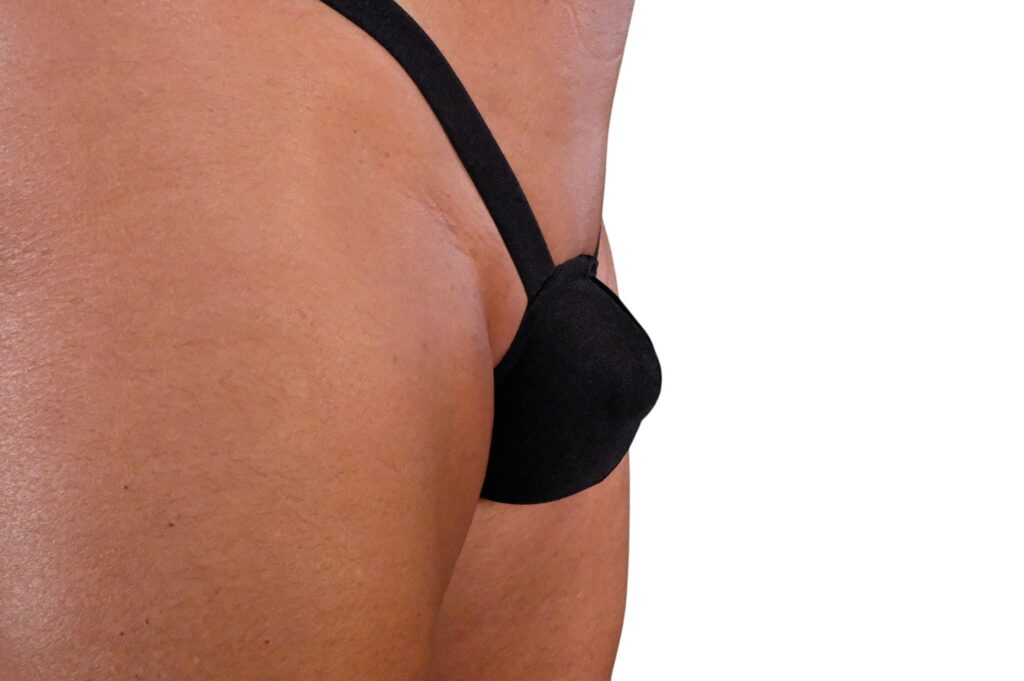
Some are essentially a compact front panel or pouch connected to narrow straps.
The purpose isn’t subtlety.
It is minimalist beachwear taken as far as the designer can reasonably take it while retaining the intended coverage.
A Swimsuit Doesn’t Define the Man
Perhaps the biggest cultural shift is the simplest one.
Men increasingly don’t need their swimsuit to prove their masculinity, sexuality or conformity to a particular fashion rule.
A masculine man can wear a bikini.
A straight man can wear a thong.
A gay man can wear board shorts.
A gender-fluid person can choose whichever silhouette expresses them best.
Swimwear is clothing—not a personality test.
That freedom allows the swimsuit itself to become more interesting.
The International Beach Is Changing
Travel also accelerates fashion change.
Someone accustomed to American board shorts might vacation in Europe and discover that brief swimwear is completely unremarkable in the places they visit. Another traveler might encounter men’s bikinis or thongs at a resort and realize that the style doesn’t feel nearly as radical when other people are wearing similar suits.
Then they bring that confidence home.
Social media does something similar without requiring the plane ticket.
Beach fashion that was once geographically isolated is now global.
The Future of Men’s Swimwear Is Choice
Board shorts aren’t disappearing.
Neither are trunks.
The real transformation is that men no longer have to be confined to those choices.
The modern men’s swimwear spectrum can include virtually everything:
Board shorts. Trunks. Square cuts. Briefs. Speedo-style suits. Bikinis. String bikinis. Thongs. G-strings. Micros. Ultra-micros.
That is a remarkable expansion from the era when many men felt that their only socially acceptable choice was a pair of shorts.
And as international fashion continues crossing borders, the distinction between “European swimwear,” “gay swimwear,” “American swimwear” and simply men’s swimwear may continue becoming less important.
Swimwear Briefs Are Only the Beginning
The classic men’s swim brief helped establish the idea that men could comfortably wear small, body-conscious swimwear.
The bikini took away more material.
The thong took away more still.
And today’s micro designs are testing just how minimal men’s beachwear can become.
Men across different countries and cultures are discovering that a swimsuit doesn’t have to look like shorts. It can be athletic, sexy, minimal, fashionable or daring.
For some men, a traditional brief is exactly right.
For others, the bikini is becoming their everyday beach suit.
And for the adventurous, even the bikini may contain more fabric than they want.
Men’s swimwear isn’t simply getting smaller. It is becoming more diverse—and men have far more freedom to decide how much swimsuit they actually want to wear.